I like documentaries. Some of my all time favorites are by British archaeologist and world class hand-talker, Michael Wood. He hooked me from the start in In Search of the Trojan War. I really loved In Search of Shakespeare but Legacy is still my all time favorite. The scene where he is quoting Gilgamesh in the commentary while the film of him sharing a fireside meal amid the ruins of Uruk with the Iraqi caretaker and his family is especially poignant.
Here is a list of some "classic" and/or award-winning documentaries and documentary makers as well as some of my personal favorites.
Amelie (Le Fabuleux Destin d'Amelie Poulain en francais - sorry I don't have an accent ague on my keyboard or a cedilla, either) - Audrey Tautou stars in this quirky, French, and fun movie. Paris and agnome. It doesn't get any better than this.
Bram Stoker's Dracula - Lasting love: Gary Oldman is a way stylin' Vlad with the shades, the fog, and the bouffant in this Francis Ford Coppola pic. It's knife-lickin' good.
Blade Runner - Replicant love: real or artificial? Harrison Ford and Sean Young give mini-blinds maximum cache' in this Ridley Scott sci-fi classic.
Boomerang - Eddie Murphy finds that perfection ain't what its cracked up to be. Perfect comedy with lots of laughs and lots of big names (Halle Berry, David Alan Grier, Tisha Campbell, Eartha Kitt, Grace Jones, and more) directed by Reginald Hudlin.
Out of Africa - Sidney Lumet's biographical tale of grand passion set against a backdrop of colonialism, natural resource exploitation, infidelity, and war with Meryl Streep in the leading role as writer, Isak Dinesan (Baroness Karen von Blixen). I've never been that attracted to Robert Redford but he is pretty hot in this movie.
Persuasion - Ciaran Hinds (Caesar in Rome, the HBO mini-series) is nautical hotness in this film version of Jane Austen's novel.
Urban Cowboy - Bud and Cissy (John Travolta and Deborah Winger): a juke joint lovestory for the ages.
I saw the Tim Burton movie version of Stephen Sondheim'smusical, "Sweeney Todd: The Demon Barber of Fleet Street", over the Christmas holiday and I enjoyed it in a cathartic sort of way. This thought provoking, Gothic tale of revenge, as overwhelmingly dark and bloody as Shakespearean tragedy, triggered a bit of Googling on my part. My search for background knowledge led to the reading of the ubiquitous Wikipedia article on the subject, which now appears to have changed since I looked at it about three weeks ago. Wikipedia is a flighty temptress, too, IMHO.
The story of Sweeney Todd is apparently an urban legend which incorporated another popular contemporaneous urban legend of human remains being used for foodstuff in Victorian London. I found this cannablistic cookery angle interestingly referenced in the Japanese anime film, "Steamboy", also set in Victorian London. The movie has a scene with a newsboy yelling the news that bones had been found in a baker's bread, which also references Jack and the Beanstalk'sgiant's rhyme. This seems to me to be a country mouse metaphor for the out-of-towner's fear of being killed and eaten by the big city literally and spirituality.
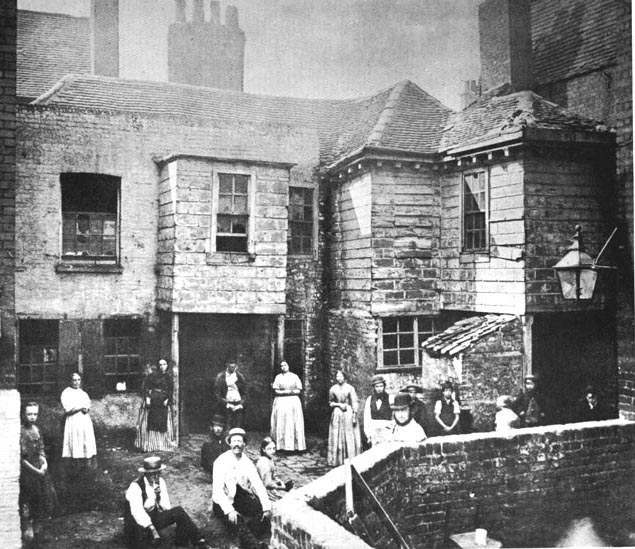
The Leviathan, London, like Jack's Giant, "ate" the lives of its swelling lower class population during the industrial revolution as they became human cogs in factory sweatshops, those "dark Satanic mills", in their efforts to support themselves. The Ghost Map by Steven Johnson, a history of the London Cholera Epidemic of 1854, details many even more unsavory job choices available to London's lower classes, such as "night soil man", "bone picker", and "tosher", trades that specialized in profitting from the mountains of waste that London produced.
Contemplating Victorian London's sanitation issues brings to mind "Oliver!" , the 1968 movie version of the Lionel Bart musical, which starred Oliver Reed and was based on Charles Dicken 's Oliver Twist, which appears to be a major influence on the musical and film of "Sweeney Todd". I was particularly reminded of two scenes at the end of "Oliver!" where Fagin is digging in the muck for his lost treasure and where Oliver witnesses Nancy's death at the hands of Bill Sykes.
Like Dickens' work, "Sweeney Todd" captures the urban despair of Victorian London, which Todd's character describes at the start of the film, as having two tiers of society; a heavenly zenith filled with successful, well-off people and a dark netherworldwhere the gin and opiate numbed masses of the poor struggle to survive. An evil beadle figures in both stories as well. In both cases he is a power-corrupted lackey from the lower world, who profits from his relationship as intermediary through abuse and extortion.
I also made a connection to the song, "LDN", by UK pop star, Lily Allen, which contains the line, "if you look twice, you'll see it's all lies", talking about the way London, or any city, looks great at first glance, but when you look closer you see the urban problems; crime, poverty, etc. I also found it interesting that barbers were historically sources for medical treatment, including amputations of diseased limbs, prior to the rise of modern medicine and the establishment of the MD as prime arbiter of body health. I can't help wondering if the urban legend of Sweeney Todd isn't partly an echo of that past when seeing the barber may have meant losing more than just your locks.
The sewer scenes and urban filth, the violent serial killings, the visit to the Victorian mad house in "Sweeney Todd", and the subject of urban legends and historical mysteries also brought to mind several related subjects, as well, and books about them.
One of the hottest books in our library is the Guinness Book of World Records. Elementary and middle schoolers, boys and girls, are particularly subject to its freakish charms. This is a great book for reluctant readers. Current circulating copies of the Guinness are usually in short supply but copies from previous years or other books on the subject heading "curiosities and wonders" can be found under the Dewey Decimal Call Number of 032.
Family Literacy helps boost a child's individual literacy skills.
For tips to increase your family's literacy from the NCFL (National Center for Family Literacy), CLICK HERE.
More ways to build family literacy:
Listening to audiobooks with your child(ren). Audiobooks allow families to listen to the same story and then to practice the skills listed in the NCFL tips website. Time spent in the car or preparing meals becomes a rich literary experience when audiobooks are added to the mix. Audio books are great for reluctant readers and help "hook" them and keep them engaged till the end of the book. They also increase listening comprehension.
Have siblings (or other family members) read to younger siblings or to each other. We now have a new series of books at CCPL called We Both Readthat is perfect for this kind of activity. These books come in a variety of beginning reading levels, from pre-kindergarden to Level 2-3. The left hand page is for the adult or fluent reader and the right hand page is for the beginning reader.
Read poetry with your children. Poetry helps engage younger children and reluctant readers. Short humorous poems are fun and appealing to children and can be easily memorized. American poetry is found under the call number, "J 811" and British poetry, such as the classic, A Child's Garden of Verses, by Robert Louis Stevenson, is found under "J 821" in the Children's section.
"Graphic Novel" is a term used to discribe books that use a comic book type of format. "Grapic Novel" describes ficion and nonfiction works of this type.
2. They provide visual information about the setting of the text. This is useful with graphic novel histories and biographies where readers are able to get more information about the clothing and environment of the time period of the work. This is especially nice for student reports requiring a visual display.
3. They are fast, exciting reads, full of color and action.
To find graphic novels on the shelves at CCPL branches, just look for the light blue "Graphic Novel" label on the spine.
In the library catalog search under the subject heading, "graphic novel". Use the subject heading "graphic novel and juvenile" to locate graphic novels in the Children's area.
For great reviews of graphic novels visit the website, No Flying No Tights (www.noflyingnotights.com).
Source Citation: Foroohar, Rana, Tracy McNicoll, Mary Acoymo, Mark Russell, and Kay Itoi. "Comic Relief; Take that, batman. Graphic novels are moving out of the hobby shop and into the mainstream." Newsweek International (August 22, 2005): 58. General OneFile. Gale. Charleston County Public Library. 29 Dec. 2007 .
One of my favorite literacy websites is author, Jon Scieszka's, Guys Read. Guys Read has reading suggestions for guys of all ages and links to author websites and more. The site is also extremely visually appealing with bright graphics and moving pages that help keep the user's attention.


 I like documentaries. Some of my all time favorites are by British archaeologist and world class hand-talker, Michael Wood. He hooked me from the start in In Search of the Trojan War. I really loved In Search of Shakespeare but Legacy is still my all time favorite. The scene where he is quoting Gilgamesh in the commentary while the film of him sharing a fireside meal amid the ruins of Uruk with the Iraqi caretaker and his family is especially poignant.


 Posts
Posts